
ESG and Glide
Glide’s core vision is to bring infrastructure to difficult to serve markets and to do this we are committed to responsible business practices which uphold our environmental, social and governance goals. This is important to us as a business as we recognise our responsibility as a leading provider of broadband services in the UK that great business is not just providing great products and service. It is also taking care of our people, our communities and making sure we do what is right for the world we live in today so we look after it for future generations.
To learn how we are doing this, please read on and find out all about our focus, commitments and actions to embrace our environmental, social and governance objectives.
Glide’s mission statement
Glide creates great customer loyalty through responsible business practices.
“Everything we do and every pound we spend should be focused around creating great customer loyalty.”
This is supported with our ESG goals and commitments.
ESG objectives
These are Glide’s principal ESG-related objectives, which guide how we conduct our business in a responsible, ethical, and sustainable manner. They reflect our commitment to embedding environmental, social, and governance considerations into our day-to-day operations, long-term strategy, and decision-making processes.
- Reducing greenhouse gas emissions
- Manage waste and improve recycling programs
- Conduct business ethically
- Work to protect human rights and equality
- Create an ethical workplace and culture
Together, these objectives form the foundation of Glide’s ESG approach, ensuring that sustainability, ethical conduct, and social responsibility are fully integrated into how we operate. This enables us to deliver long-term value for our customers, employees, and wider stakeholders, while supporting the transition to a more sustainable and responsible business environment.
Net Zero strategy and actions
Climate change is a global priority, with governments (including the UK) legally committed to net zero targets. Businesses play a critical role in reducing emissions across energy use, supply chains and operations. A robust strategy helps organisations stay compliant, competitive and resilient in a low-carbon economy.
Glide’s Net Zero Strategy sets out how we plan to reduce our greenhouse gas emissions to as close to zero as possible. It provides a structured, long-term roadmap to align our business operations and activities with global climate goals, including limiting global warming to 1.5 degrees C and achieving net zero by 2050.
What our strategy includes
Our Net Zero strategy sets out a clear roadmap to measure, manage and reduce our greenhouse gas emissions across all operations, supporting the transition to a low‑carbon economy while delivering long‑term value for our business and stakeholders.
Our approach
Our GHG strategy follows a clear framework:
- Measure – assess emissions using recognised methodologies.
- Reduce – prioritise actions to lower emissions at source.
- Remove – address residual emissions through carbon removal.
- Report – monitor and communicate progress regularly.
Glide’s strategy covers:
- Baseline measurement of emissions (scopes 1, 2 and 3).
- Science-based targets aligned to climate goals.
- A decarbonisation plan to remove emissions at source.
- Governance and reporting to track progress.
Why these matter
Our customers increasingly expect organisations, including us, to take a proactive and transparent approach to climate responsibility. Climate performance is no longer viewed as a standalone sustainability initiative but as a core requirement of long-term business resilience, value creation and risk management.
Service providers and organisations are expected to show their progress in reducing their operational environmental impacts through a credible, transparent and measurable progress plan. This requires robust emission data, clear targets and regular reporting.
These expectations are driving a shift from ambition to accountability – where organisations must not only set climate goals but also demonstrate tangible action, transparency and continuous improvement to maintain trust, competitiveness and long-term stakeholder confidence.
Our Net Zero strategy and actions document can be found here.
From ambition to action – our GHG Report
Our Greenhouse Gas report outlines our commitment to measuring, managing and reducing emissions across our operations. It tracks the progress we are making towards our net zero targets.
The report is based on a comprehensive assessment of our emissions footprint, covering Scopes 1, 2 and 3 emissions. It provides a structured approach to identifying key emission sources and implementing targeted reduction actions.
Our GHG report includes the following:
- A baseline of our current emissions and key drivers.
- Tracking of progress against our targets and commitments.
- Transparent reporting of our progress against our strategy and action plan.
This approach supports continuous improvement and aligns our business with wider climate goals and regulatory expectations.
Our Greenhouse Gas Emissions report can be found here.
Our Global ESG Rating through GRESB – 4 Stars
Glide participates in Environmental, Social and Governance (ESG) validation through GRESB. GRESB is a global ESG benchmark and assessment organisation focused on real estate and infrastructure assets (eg buildings, networks, utilities, data infrastructure). They provide independent, global ESG validation and benchmarking through the collection of data.
Glide utilises the assessment report to review our position against the different ESG elements measured and to focus on delivering improvements across our ESG-related activities.
Glide scored 97.7 out of 100 points; GRESB confirmed a 4-star rating was achieved.
GRESB operates a scoring methodology based on quintile position, not just simply the score achieved out of the maximum 100 points available. The rating scores are dependent on all participants and the scores achieved. The ratings are calibrated annually, based on the overall results of participants.
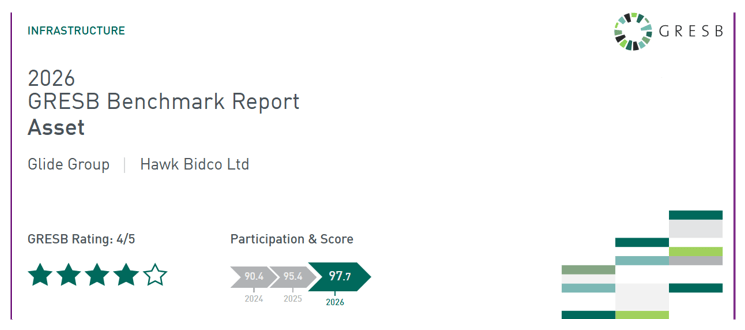
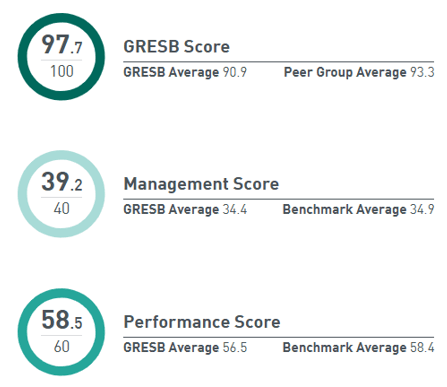
GRESB operates within peer groups based on the participant’s business activities and geographical location. Glide achieved above average scores.
The assessment is split between two separate groups: Management and Performance components. Each component is scored and materiality to the business activity is taken into consideration when scoring.
- Management component measures strategy and leadership, policies and processes, risk management and stakeholder engagement.
- Performance component measures 12 aspects of performance, including energy, greenhouse gas emissions, air pollution, waste management, health and safety, employees and customers.
ISO 14001 Environmental Management System
ISO 14001 provides Glide with a structured and systematic approach to managing our environmental responsibilities and driving continuous improvement in our environmental performance. As an internationally recognised Environmental Management System (EMS), it ensures that our approach to carbon reduction is embedded into governance, decision-making, and day-to-day operations.
Through ISO 14001, Glide is able to identify and assess the environmental impacts of our activities, set clear objectives and targets, and implement controls to reduce our greenhouse gas emissions. It supports the integration of carbon reduction into business processes, ensuring that environmental considerations are factored into operational planning, procurement, infrastructure design, and service delivery.
The framework also strengthens accountability and transparency by requiring regular monitoring, measurement, and reporting of environmental performance. This enables us to track progress against our carbon reduction goals, demonstrate compliance with regulatory requirements, and provide credible evidence for external stakeholders, including ESG assessments such as GRESB.
Importantly, ISO 14001 drives a culture of continual improvement, ensuring that Glide regularly reviews its environmental risks and opportunities, refines its carbon reduction initiatives, and adapts to evolving best practice and regulatory expectations. This supports the long-term delivery of our net zero strategy and reinforces our commitment to operating as a responsible and sustainable business.
Carbon reduction projects
Glide’s carbon reduction approach combines targeted projects with ongoing business-as-usual activities to embed sustainability across our operations. By integrating low-carbon practices into both strategic initiatives and day-to-day delivery, we ensure continuous improvement in reducing emissions. Together, these actions form a practical and measurable pathway towards achieving our net zero goals.
Simplifying the network and reducing power consumption
Glide’s network efficiency programme is a key component of our carbon reduction and infrastructure modernisation strategy, bringing together our cabinet refresh and network simplification initiatives to deliver improved performance, enhanced customer experience, and significant reductions in energy consumption across our network and data centre environments.
The programme focuses on replacing legacy equipment and optimising network architecture to create a more efficient, resilient, and scalable infrastructure. A core element of this approach is the transition from active to passive systems wherever technically and operationally feasible. By converting cabinets to passive infrastructure, we remove the requirement for powered components entirely, eliminating ongoing electricity usage at these sites and delivering a direct reduction in greenhouse gas emissions.
Alongside this, Glide is simplifying complex, legacy network environments that have developed organically over time. By rationalising and streamlining these systems, we reduce duplication, improve manageability, and lower the overall energy required to operate and maintain the network. This simplification is complemented by the removal of power-intensive infrastructure and its replacement with modern, energy-efficient hardware, which provides enhanced performance with significantly lower energy demand.
These combined activities deliver both environmental and operational benefits. Energy consumption is reduced across the network, lowering carbon emissions and supporting Glide’s net zero commitments, while improved infrastructure design enhances reliability, scalability, and service continuity. At the same time, the reduction in active components and legacy systems leads to lower maintenance, servicing, and replacement requirements, helping to streamline asset management and reduce operational costs.
From a commercial perspective, the programme is designed to achieve sustained financial efficiencies through reduced power costs and simplified operational processes. By embedding energy efficiency into the core design and ongoing management of our network, Glide is able to balance performance, cost control, and sustainability.
Overall, Glide’s network efficiency programme demonstrates our commitment to integrating sustainability into core infrastructure decisions. By combining network simplification with targeted modernisation and passive infrastructure conversion, we are delivering measurable reductions in energy use and carbon emissions while strengthening long-term business resilience and supporting the delivery of our net zero strategy.
Packaging changes – reducing plastic packaging from our supply chain
Glide is committed to minimising waste and reducing the environmental impact associated with packaging across our supply chain. We recognise the importance of tackling packaging at both the source and within our own operational processes to reduce landfill waste and support a more circular economy.
A key focus of our approach is working collaboratively with suppliers who demonstrate a commitment to sustainable packaging practices. Wherever possible, we prioritise suppliers that use recyclable and lower-impact materials, such as cardboard and paper-based alternatives, in place of single-use plastics. This not only reduces the volume of non-recyclable waste entering our operations but alsosupports responsible sourcing and encourages improved environmental standards across our supply chain.
Internally, Glide actively promotes the reuse of packaging materials across operational activities. Packaging received from suppliers is retained and reused where suitable, extending its lifespan and reducing the need for additional materials. This approach helps to lower both waste generation and the embedded carbon associated with producing new packaging.
For packaging that cannot be reused, we implement appropriate segregation and recycling processes to ensure materials are diverted from landfill wherever possible. By embedding these practices into our day-to-day operations, we strengthen our waste management processes and contribute to reducing our overall environmental footprint.
Looking ahead, Glide continues to review opportunities to further reduce packaging intensity, improve material efficiency, and work with suppliers to phase out unnecessary or high-impact packaging. Through these measures, we aim to drive continuous improvement, reduce plastic dependency, and support our broader commitment to sustainable and responsible business practices.
Vehicle strategy and fleet optimisation
Glide recognises that business travel is an essential part of our operations, enabling us to meet customer needs, maintain service quality, and deliver excellent outcomes across our network and client base. At the same time, we are committed to balancing these operational requirements with our responsibility to reduce carbon emissions.
Our approach focuses on minimising unnecessary travel while ensuring that business miles are undertaken where they deliver clear operational or customer value. We actively promote smarter ways of working—including remote collaboration, efficient route planning, and the consolidation of site visits—to reduce overall travel demand.
In parallel, we continue to reduce the environmental impact of our transport activities through the ongoing optimisation of our vehicle fleet. This includes a reduction in fleet size where appropriate, the return or removal of underutilised vehicles, and the continuous evaluation of lower-carbon alternatives as technology and operational suitability evolve.
By embedding these principles into our day-to-day decision making, we aim to strike the right balance between operational excellence and environmental responsibility, ensuring that our services remain both high-quality and increasingly sustainable.
Marketing materials – reduce printed literature
Glide is committed to minimising the environmental impact of its marketing activities by prioritising low-carbon, resource-efficient approaches. Our marketing strategy is designed to reduce waste, limit emissions, and promote sustainable practices without compromising on brand visibility or customer engagement.
This includes a significant reduction in the use of printed materials, such as leaflets and flyers, with a shift towards digital alternatives wherever possible. At events, we utilise QR codes to provide instant access to information, reducing the need for printed collateral. We also prioritise reusable materials by avoiding time-sensitive banners and displays, ensuring that assets can be utilised across multiple campaigns.
In addition, we are reducing the carbon footprint associated with logistics by minimising the volume of marketing kits and displays required at events, thereby limiting the need for courier services and transportation.
Through these measures, Glide aims to embed sustainability into all aspects of its marketing activity, supporting our wider commitment to reducing greenhouse gas emissions and operating as a responsible, environmentally conscious business.
Building resilience to climate-related risk
Building resilience to climate-related risks and opportunities is essential to Glide’s long-term success and sustainability. As climate change continues to impact regulatory expectations, infrastructure performance, supply chains, and customer needs, it is critical that our strategy not only manages risk but also positions the business to respond effectively and responsibly.
By proactively understanding and managing climate-related risks, adapting to changing conditions, integrating sustainability into core operations, and identifying emerging opportunities, Glide can protect its services, maintain operational continuity, and strengthen its competitive position. This approach ensures we are not only mitigating adverse impacts but also enabling the business to thrive in a rapidly evolving environmental and economic landscape.
Glide’s resilience strategy is underpinned by the following key areas:
- Risk assessment and management: Glide actively implements adaptation measures to minimise the physical and operational impacts of climate change. This includes enhancing the efficiency and resilience of our network infrastructure, reviewing asset design and maintenance practices, and adapting operational processes to respond to changing environmental conditions. By future-proofing our infrastructure and operations, we reduce exposure to climate-related disruptions and improve service continuity.
- Adaption measures: Glide actively implements adaptation measures to minimise the physical and operational impacts of climate change. This includes enhancing the efficiency and resilience of our network infrastructure, reviewing asset design and maintenance practices, and adapting operational processes to respond to changing environmental conditions. By future-proofing our infrastructure and operations, we reduce exposure to climate-related disruptions and improve service continuity.
- Sustainability integration: Sustainability is embedded into Glide’s core business strategy and decision-making processes. This includes setting clear carbon reduction targets, implementing our net zero roadmap, investing in energy-efficient technologies, and incorporating environmental considerations into procurement and operational planning. By integrating sustainability into everyday business activities, we ensure that carbon reduction and environmental responsibility are consistently applied across the organisation.
- Stakeholder engagement: We actively engage with key stakeholders – including customers, employees, suppliers, investors, and regulators – to understand expectations and align our climate-related initiatives accordingly. This collaboration enables us to respond to emerging requirements, enhance transparency, and drive collective progress on sustainability goals. Supplier engagement, in particular, plays a critical role in addressing Scope 3 emissions and strengthening resilience across our value chain.
Governance – how we manage our business
Glide has worked hard to build and maintain a strong reputation based on trust, integrity, and responsible business conduct. Our governance framework plays a central role in supporting this, ensuring that all employees understand and adhere to clear standards of behaviour. These standards are set out in company policies designed not only to uphold our reputation for fairness and transparency, but also to protect employees from any perception of bias or partiality in commercial decision-making.
We have established documented quality standards that define the level of service our customers can expect from us. These standards are actively monitored, measured, and reviewed to ensure performance is maintained and continually improved. This commitment to quality extends across the organisation, with high expectations placed on all managers and employees to act professionally, ethically, and in line with our business values in every interaction and transaction.
Our governance structure is based on clearly defined goals, objectives, and responsibilities, supported by a robust framework of rules, practices, and processes used to direct and control the business. This includes effective oversight, accountability, and decision-making structures that ensure consistency and alignment across all business areas.
Through this structured approach, Glide ensures that governance is not only about compliance but also about enabling effective leadership, responsible growth, and continuous improvement. By embedding strong governance into our day-to-day operations, we support long-term business resilience, strengthen stakeholder confidence, and ensure that our business is managed in a transparent, ethical, and sustainable manner.
Social responsibility
The management of Glide recognises that the day-to-day operations and decisions can impact people and the environment, including those we serve in our communities as well as our employees. We aim to protect the society we are part of through good management and by adopting best practice, being open and transparent wherever possible.
We will continue to work to integrate social responsibility considerations into our business decisions and treat everyone involved in our business fairly. This includes conducting our business ethically with honesty and transparency. We are also committed to eliminating risks to the environment, where possible, through selection and design of materials, buildings, facilities, equipment and processes to therefore eliminate risks and impacts on society.
Diversity, equity and inclusion
Glide is an equal opportunity employer.
The company is committed to being a successful, caring and welcoming place for all employees. We want to create a supportive and inclusive environment where our employees can reach their full potential without prejudice and discrimination. We are committed to a culture where respect and understanding are fostered, and the diversity of people’s backgrounds and circumstances will be positively valued.
We aspire to represent the local community we operate in, and this is something we currently excel at.
Equality of opportunity, valuing diversity and compliance with the law are to the benefit of all individuals in our company as it seeks to develop the skills and abilities of its people. While specific responsibility for eliminating discrimination and providing equality of opportunity lies with managers and supervisors, individuals at all levels have a responsibility to treat others with dignity and respect.
Through our policy and procedure and the training and development of managers and staff, the organisation will do all it can to promote good practice in this area in order to eliminate discrimination and harassment as far as is reasonably possible. The Company will also continue to work towards its dedicated goal of encouraging and promoting equality and diversity within the workforce.
Glide is also proud to share that we are certified as a Disability Confident Committed Employer, and we have committed to the following:
- ensure our recruitment process is inclusive and accessible
- communicating and promoting vacancies
- offering an interview to disabled people who meet the minimum criteria for the job
- anticipating and providing reasonable adjustments as required
- supporting any existing employee who acquires a disability or long-term health condition, enabling them to stay in work
- at least one activity that will make a difference for disabled people
Find out more about Disability Confident at: www.gov.uk/disability-confident