

Carbon Reduction Plan
Glide Student & Residential Limited
Publication date: October 2026
Commitment to achieving Net Zero
Glide Student & Residential Limited is committed to achieving Net Zero emissions by 2050.
Baseline Emissions Footprint
Baseline emissions are a record of the greenhouse gases that have been produced in the past and were produced prior to the introduction of any strategies to reduce emissions. Baseline emissions are the reference point against which emissions reduction can be measured.
| Baseline Year: 2024 | |
| Additional Details relating to the Baseline Emissions calculations. | |
| We use 2024 (FY2025, February 2024 to January 2025) as our baseline because it is the first year in which we captured our Scope 3 emissions. This gives us a complete reference point across all three scopes against which to measure progress. Emissions are reported for Glide Group on an operational control basis, which includes Glide Student & Residential Limited. We calculate our footprint annually in line with the GHG Protocol Corporate Standard (GWP100) using the Greenly carbon accounting platform, which applies UK Government conversion factors alongside other verified emission factor databases. In FY2026, 92% of our footprint was calculated from physical activity data and 8% from spend data. Our Scope 3 reporting covers categories 1 to 8: purchased goods and services, capital goods, fuel and energy related activities, upstream transportation and distribution, waste, business travel, employee commuting and upstream leased assets. Categories 9, 10 and 13 to 15 are not relevant to our operations, and categories 11 and 12 (use and end of life treatment of sold products) are currently excluded. Purchased digital infrastructure, principally data centre and physical server capacity, accounts for more than 90% of our footprint, which is why our Scope 3 total is so much larger than our Scope 1 and 2 emissions. | |
| Baseline year emissions: | |
| EMISSIONS | TOTAL (tCO2e) |
| Scope 1 | 197 |
| Scope 2 | 148 |
| Scope 3 (Included Sources) | 76,050 |
| Total Emissions | 76,395 |
Current Emissions Reporting
| Reporting Year: 2026 | |
| EMISSIONS | TOTAL (tCO2e) |
| Scope 1 | 210 |
| Scope 2 | 106 |
| Scope 3 (Included Sources) | 76,570 |
| Total Emissions | 76,886 |
Emissions reduction targets
In order to continue our progress to achieving Net Zero, we have adopted the following carbon reduction targets.
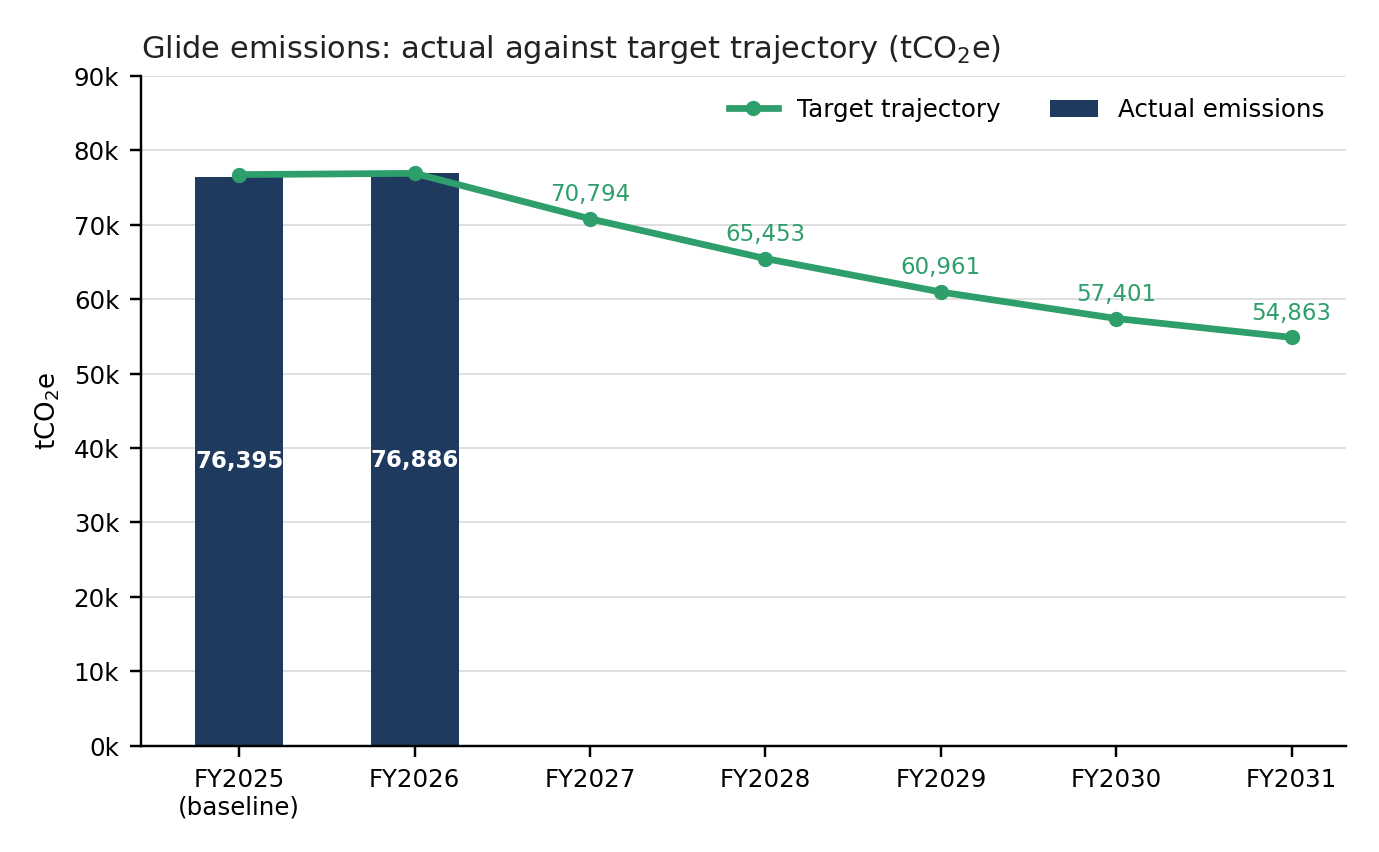
We project that carbon emissions will decrease over the next five years to 57,401 tCO2e by 2030. This is a reduction of 25%
Progress against these targets can be seen in the graph below:
Carbon Reduction Projects
Completed Carbon Reduction Initiatives
The following environmental management measures and projects have been completed or implemented since the 2024 baseline. The carbon emission reduction achieved by these schemes equate to 42 tCO2e, a 28%ge reduction against the 2024 baseline and the measures will be in effect when performing the contract
- ISO 14001 environmental management. We have held ISO 14001 certification for several years. It gives us a structured way to identify the environmental impact of our activities, set objectives and targets, and drive continuous improvement.
- Network simplification and lower power consumption. Our network efficiency programme is reducing energy use across our network and data centre estate. At one data centre, average consumption has fallen from around 30,000 kWh a month in 2022 to around 19,000 kWh a month in 2025.
- Office consolidation. We have closed two sites and brought teams together in our remaining offices, reducing annual office energy consumption by about 30% between 2022 and 2025.
- Fleet optimisation. We have reduced the size of our vehicle fleet and focus on minimising unnecessary travel.
- Packaging. We prioritise suppliers that use recyclable, lower impact materials such as cardboard and paper in place of plastic packaging.
- Marketing materials. We have significantly reduced printed literature and use QR codes to give customers instant access to information.
- Accurate measurement. We measure our full Scope 1, 2 and 3 footprint annually, with 92% now based on physical activity data rather than spend.
Future carbon reduction initiatives
In the future, we hope to implement further measures, such as:
- Real PUE for data centres. We will replace industry estimates with measured Power Usage Effectiveness data at the data centres where we have presence, showing where energy is lost to cooling and other overheads so we can target it. Estimated saving by 2030: 13,090 tCO2e (17%).
- Carbon impact conditions in our purchasing policy. We will build carbon criteria into how we buy goods and services. Estimated saving by 2030: 790 tCO2e (1%).
- Supplier climate maturity. We will assess our suppliers through surveys and monitor their emissions and alignment with the Paris Agreement and SBTi. This saving is not yet quantifiable.
- Passive roadside cabinets. Passive cabinets have no electronic components and need no power supply, removing local electricity consumption entirely for those parts of the network. Estimated saving by 2030: 45 tCO2e.
- Further office reduction. We will complete our office consolidation during 2026. Estimated saving: 5 tCO2e.
- Lower carbon fleet. We will continue to review lower carbon alternatives for our vehicle fleet.
- UK grid decarbonisation. Our trajectory also reflects the decarbonisation of the UK electricity grid, estimated to reduce our emissions by around 28,890 tCO2e (38%) by 2030. This is not within our direct control.
Declaration and Sign Off
This Carbon Reduction Plan has been completed in accordance with PPN 006 and associated guidance and reporting standard for Carbon Reduction Plans.
Emissions have been reported and recorded in accordance with the published reporting standard for Carbon Reduction Plans and the GHG Reporting Protocol corporate standard1 and uses the appropriate Government emission conversion factors for greenhouse gas company reporting2.
Scope 1 and Scope 2 emissions have been reported in accordance with SECR requirements, and the required subset of Scope 3 emissions have been reported in accordance with the published reporting standard for Carbon Reduction Plans and the Corporate Value Chain (Scope 3) Standard3.
This Carbon Reduction Plan has been reviewed and signed off by the board of directors (or equivalent management body).
Signed:
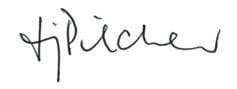
Tim Pilcher
Chief Executive Officer
30 September 2026
[1]https://ghgprotocol.org/corporate-standard
[2]https://www.gov.uk/government/collections/government-conversion-factors-for-company-reporting